Manage your food drive volunteers
Fifteen stores, two days, two-hour shifts: a food drive is not scheduled, it is filled. And keying in three hundred shifts by hand is work nobody should be doing.
The volunteer books, you confirm
On a food drive, the organiser does not know in advance who can come on Saturday from 10am to noon to the store on the north side. The volunteer does. Shift booking therefore turns the work around: you declare the stores and the shifts with their head count, volunteers take theirs, and you confirm. Immediately, or after a manager's approval, depending on what you set.
Full shifts accept substitutes and a waiting list: when somebody pulls out, the first substitute is promoted and notified, without you having to notice.
One store, one team, one manager
Each store becomes a team with its own manager, who watches their own shifts fill up and chases their own people. You keep the overall picture: the stores that are full, those that are not, and the Sunday-afternoon gaps that have to be gone after. See teams and positions.
Partner organisations and constituted groups
A parish, a school, a works council bringing twenty people: Volunteer groups give them their sign-up link and their own managers, so they organise themselves without going through you.
And the instructions, tabards and sign-in sheets
Mail merge produces each volunteer's sheet from a Word template (store, hours, instructions, manager's contact), and badges identify volunteers at the store entrance. Those are the two documents you print on Friday evening.
Every team has its own lead
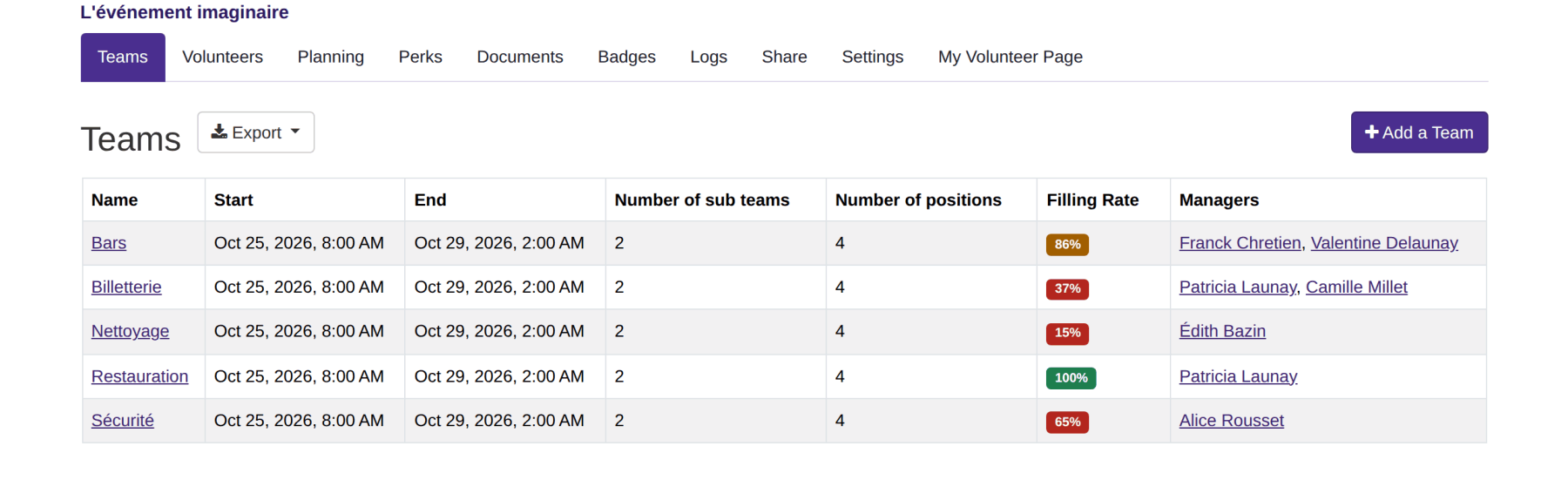
The event is split into teams: bar, welcome desk, security, set-up, shuttles. Each one goes to one or more leads, who create their own positions and assign their own volunteers without access to the rest of the organisation.
This page gives the filling rate of every team, and one click takes you down into the one that is stuck. You have nobody to ask to know where the event stands.
A position is a dated assignment
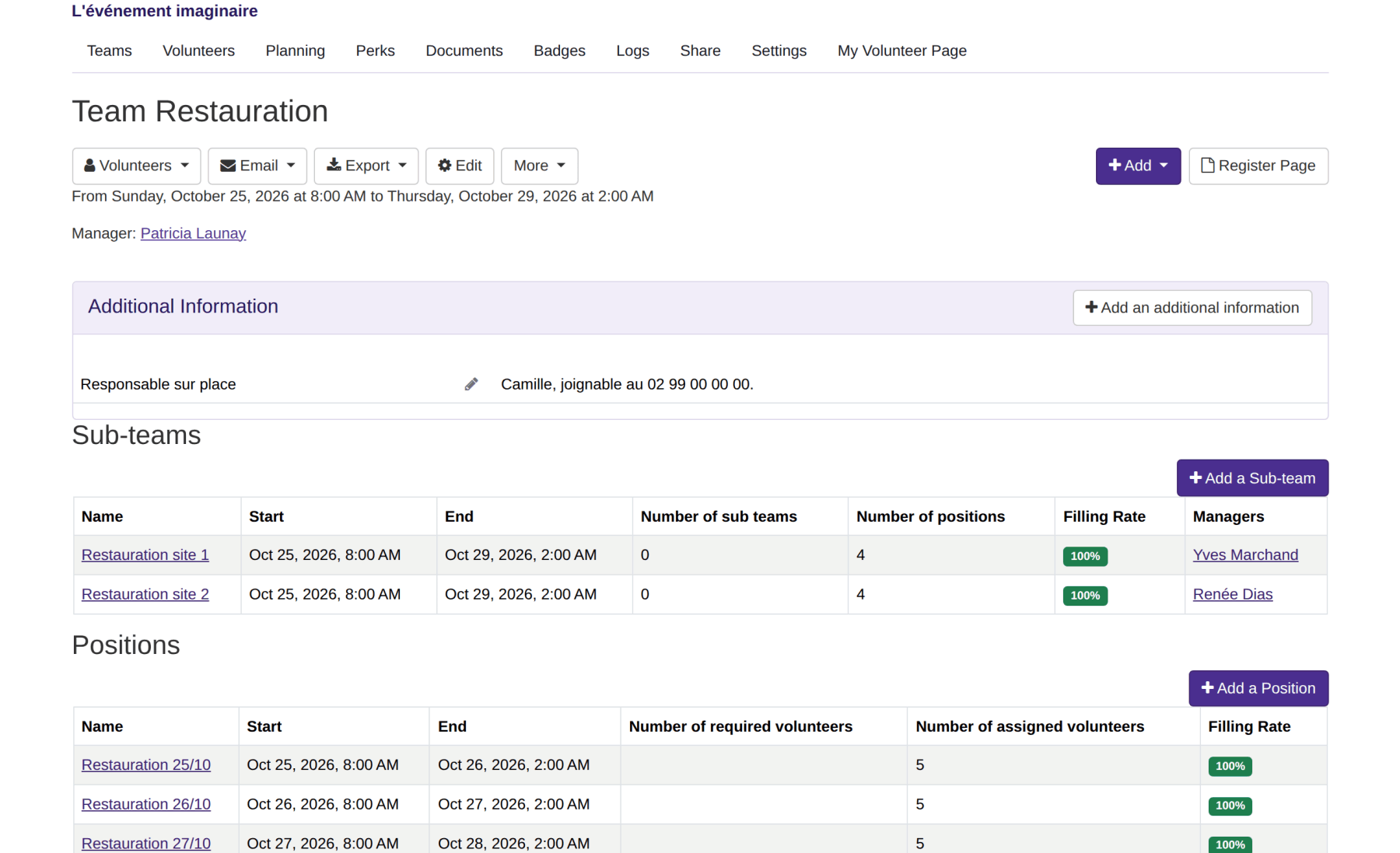
Inside a team, a position says what has to be done and between which hours: the Saturday bar, from 8am to 2am. A team splits into sub-teams where it needs to, by site or by day, each with its own leads.
The next edition is created from this one, with its teams, its positions, their hours and their requirements. You adjust what changed, the rest is already there.
Requirements are declared hour by hour
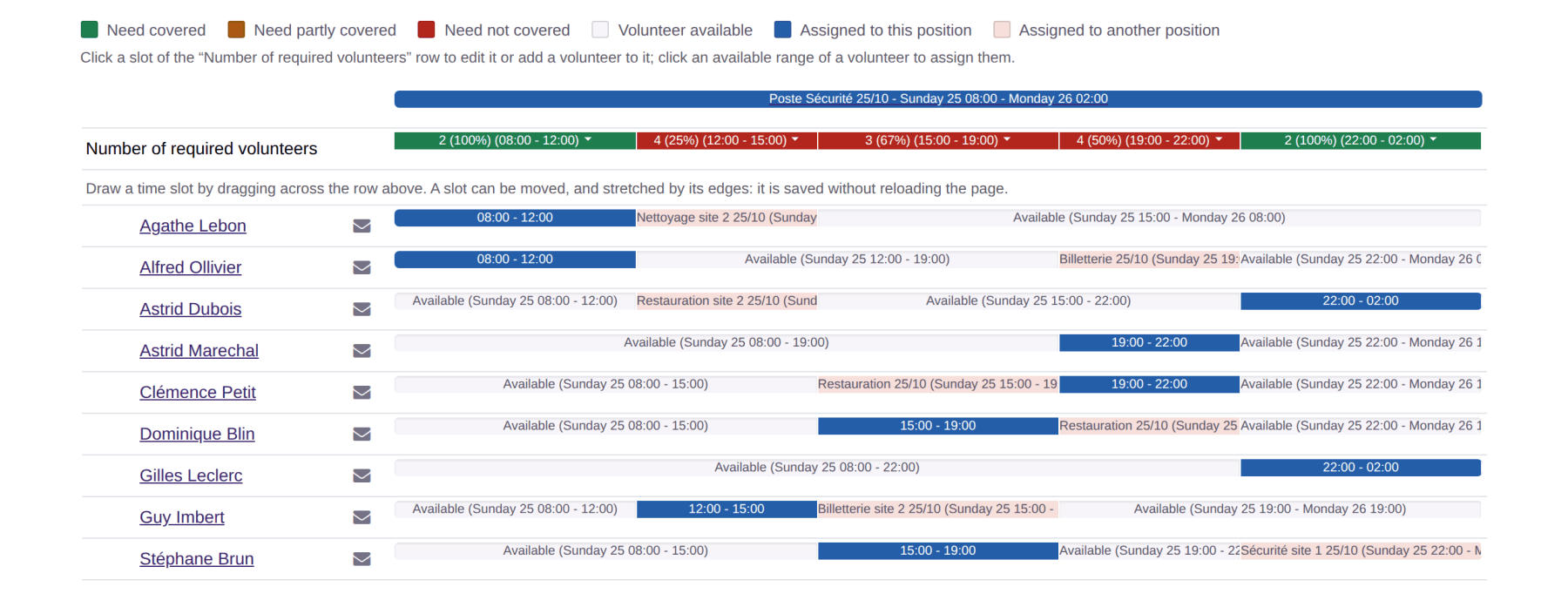
A position does not need the same headcount all day: two people from 8am to noon, four from noon to 3pm. The filling rate is read on those bands, and that is where a gap shows up while there is still time to fill it.
Opposite, every volunteer shows the availability they declared and the positions they already hold. An assignment that contradicts them is refused, every time, without you having to think about it.
Features
Volunteer registration
One public link, a QR code and a form that asks your own questions: applications arrive already sorted by preferred team and by availability.
Volunteer import and export
Bring your list in from a spreadsheet, as CSV or Excel, and take your volunteers, schedules and their answers back out whenever you want.
Volunteer tracking
Filter by status, team, availability or assigned position, choose your columns, and find each volunteer's full history.
Teams and positions
Split the event into teams and positions, hand each team to its lead, and say how many volunteers you need, hour by hour.
Volunteer scheduling
Assign people without ever creating a clash, follow staffing position by position, and send everyone their own schedule.
Shift booking
Let volunteers pick their own shifts, with substitutes and a waiting list, while you keep control of confirmation.
The volunteer's account
Every volunteer has their own page: their next shift, their hours, their documents, their perks, and their calendar up to date on their phone.
Emails to volunteers
Write in two clicks to a team, a position, unassigned volunteers or everyone, from reusable templates.
Documents and mail merge
Call-up letters, certificates, running sheets: one Word template, and one document per volunteer filled in with their details and schedule.
Badges and perks
Print badges with a photo and a QR code, and track the meals, drinks and t-shirts handed to each volunteer.
Volunteer groups
A partner organisation brings its own volunteers? Give it its own sign-up link and its own leads, without opening up the whole event.
A new edition every year
The new edition carries over teams, positions and hours shifted to the right dates, and last year's volunteers are invited back.
Volunteer data and GDPR
Hosted in France, a published processing agreement, and retention periods applied by code rather than merely announced.
Accessibility for volunteers
Measured screen by screen and published: 100% of the applicable RGAA 4.1 criteria, self-assessed, and a statement that also says what that does not cover.
Events of all sizes simplify their organisation with Volunteo

75 volunteers

300 volunteers

1600 volunteers

3000 volunteers
Frequently asked questions
Does booking a shift use up a credit?
No. Only accepting a volunteer onto the event is billed. A volunteer can book a shift and stay pending approval without it counting.
Can we run a drive every month?
Yes. An organisation collecting all year round can choose the annual licence rather than credits: a fixed price for the edition, up to a ceiling of volunteers, with weekly shift series.
Do our volunteers need a computer?
No, shift booking works from a phone. A manager can also sign somebody up and place them on their behalf.