
Volunteer groups
Many events do not only recruit individuals: they lean on collectives: a sports club running the bar, a local association taking the car park, a branch sending fifteen people. Those collectives want to manage their own people, and you have no wish to open the whole event to them.
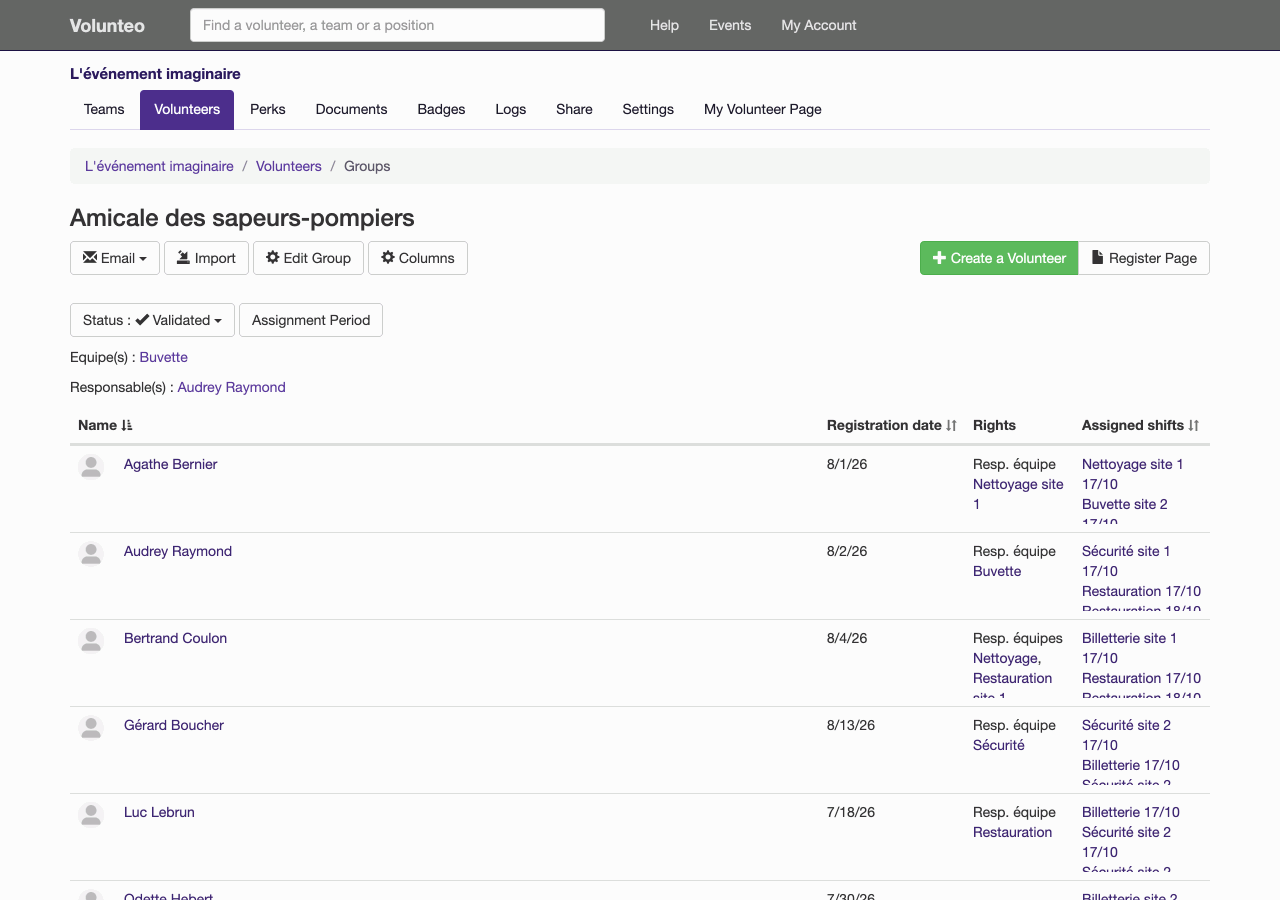
A group, its leads, its scope
A group gathers a subset of your volunteers, attached to one or more teams, and given its own leads. They manage their volunteers (follow them, assign them within their scope, write to them), without seeing or touching the rest of the organisation.
It is an intermediate layer of delegation, between the event manager who sees everything and the team lead who sees one mission. It matches a reality most tools ignore: an organisation is not only divided by work, it is also divided by where people belong.
Its own sign-up link
Every group has its own sign-up address. The club shares it with its members; volunteers who come through that link are attached to the group from the moment they sign up. Nobody has to find them afterwards in a list of three hundred names, and the partner watches its own headcount rise in real time.
A group can also have its own contact form, writing to its leads rather than to yours: questions internal to the club stay internal to the club.
What you gain
- You stop being the middleman. Name lists sent by email, spreadsheets crossing each other, chasing the club chair: all of it goes away.
- The partner stays at home. Full autonomy over their volunteers, no visibility on the others.
- You keep the overall view. A group's volunteers are volunteers of the event like any others: they count towards staffing, they receive your emails, they appear in your exports.
When to switch it on
Groups are set per edition and only appear once you enable them. An event that recruits individuals only never sees a trace of them; an event leaning on ten partner organisations gains ten autonomous co-organisers.
For the division of the work itself, see teams and positions.
Frequently asked questions
How is a group different from a team?
A team describes the work to be done, the bar, the welcome desk. A group describes where people come from: the rugby club, the Quimper branch, a company's staff association. A group is attached to one or more teams and has its own leads; it is a layer of delegation, not a division of the work.
Does the partner see the whole event?
No. The group's leads manage the volunteers of their group, within the teams attached to it. The rest of the event is none of their business and is not open to them.
How does the partner recruit its volunteers?
It shares the group's own sign-up link. Volunteers who come through that link are attached to the group automatically, with no sorting to do afterwards in the general list.
Read next
A new edition every year
The new edition carries over teams, positions and hours shifted to the right dates, and last year's volunteers are invited back.
Volunteer data and GDPR
Hosted in France, a published processing agreement, and retention periods applied by code rather than merely announced.
All features
- Volunteer registration
- Volunteer import and export
- Volunteer tracking
- Teams and positions
- Volunteer scheduling
- Shift booking
- The volunteer's account
- Emails to volunteers
- Documents and mail merge
- Badges and perks
- Attendance check-in
- Volunteer groups
- A new edition every year
- Volunteer data and GDPR
- Accessibility for volunteers