Manage your street outreach volunteers
A crew of three, every other evening, November to March. An outreach round never falls through for being oversubscribed: it falls through because one person was missing at 7pm.
The problem is the evening somebody is missing
On a round, head count is not a comfort: below three, it does not go out. A position therefore carries its required head count hour by hour, and Tuesday's 7pm shift reads two out of three for as long as one person is missing. That is the screen you look at on Monday, and the only figure that matters.
Once a crew is full, further sign-ups become substitutes. A 6pm cancellation promotes the first of them and notifies them by email, with nobody keeping a waiting list by hand. See shift booking.
A season is declared once
Outreach rounds are not invented afresh every week: every other evening, same meeting point, same length. Weekly shift series write the whole season in one go, and the exceptions (holidays, cold-snap reinforcements) are corrected shift by shift.
Trained crews, and everybody else
Outreach mixes seasoned volunteers with newcomers, and that mix is decided rather than suffered. Each round group is a team with its own lead, who approves who joins the crew. A volunteer who has not attended the induction evening stays pending, visible, and appears on no round until they are accepted.
What the lead takes with them
Mail merge produces the evening's round sheet from a Word template: who is in the crew, phone numbers, the area, the instructions. Emails to volunteers remind those who are booked the day before, and only them.
A winter activity is paid for by the year
You mobilise the same people five months running: the annual licence replaces counting with a fixed price, with a ceiling of accepted volunteers and weekly series included. Next winter you start again from your teams and your rounds.
Every team has its own lead
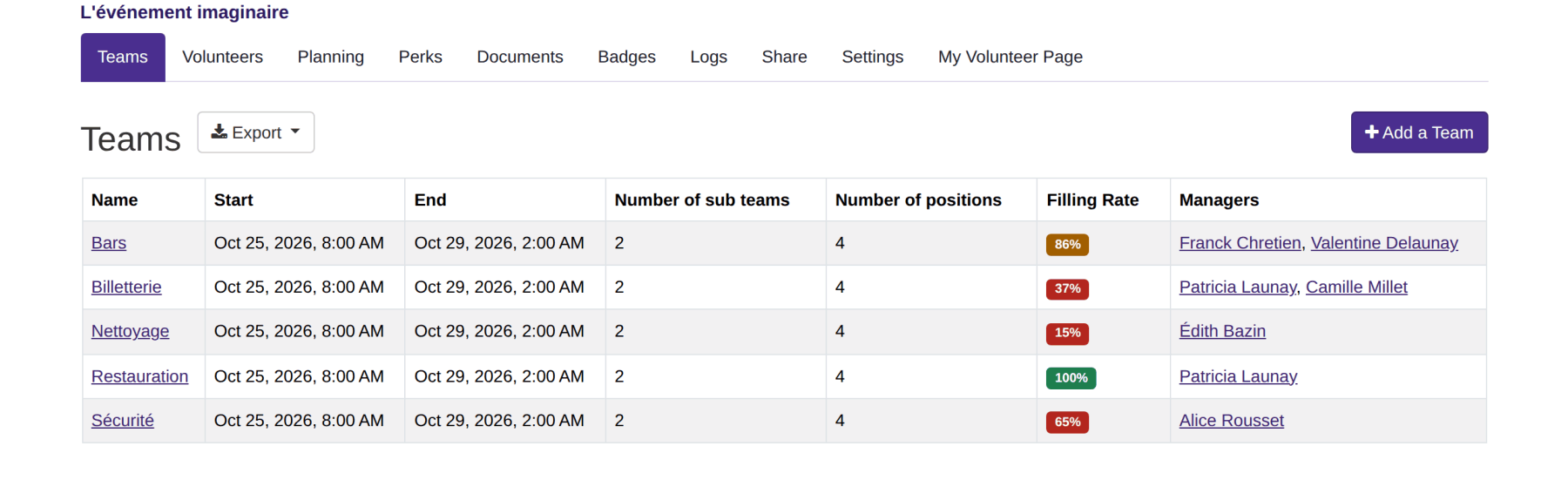
The event is split into teams: bar, welcome desk, security, set-up, shuttles. Each one goes to one or more leads, who create their own positions and assign their own volunteers without access to the rest of the organisation.
This page gives the filling rate of every team, and one click takes you down into the one that is stuck. You have nobody to ask to know where the event stands.
A position is a dated assignment
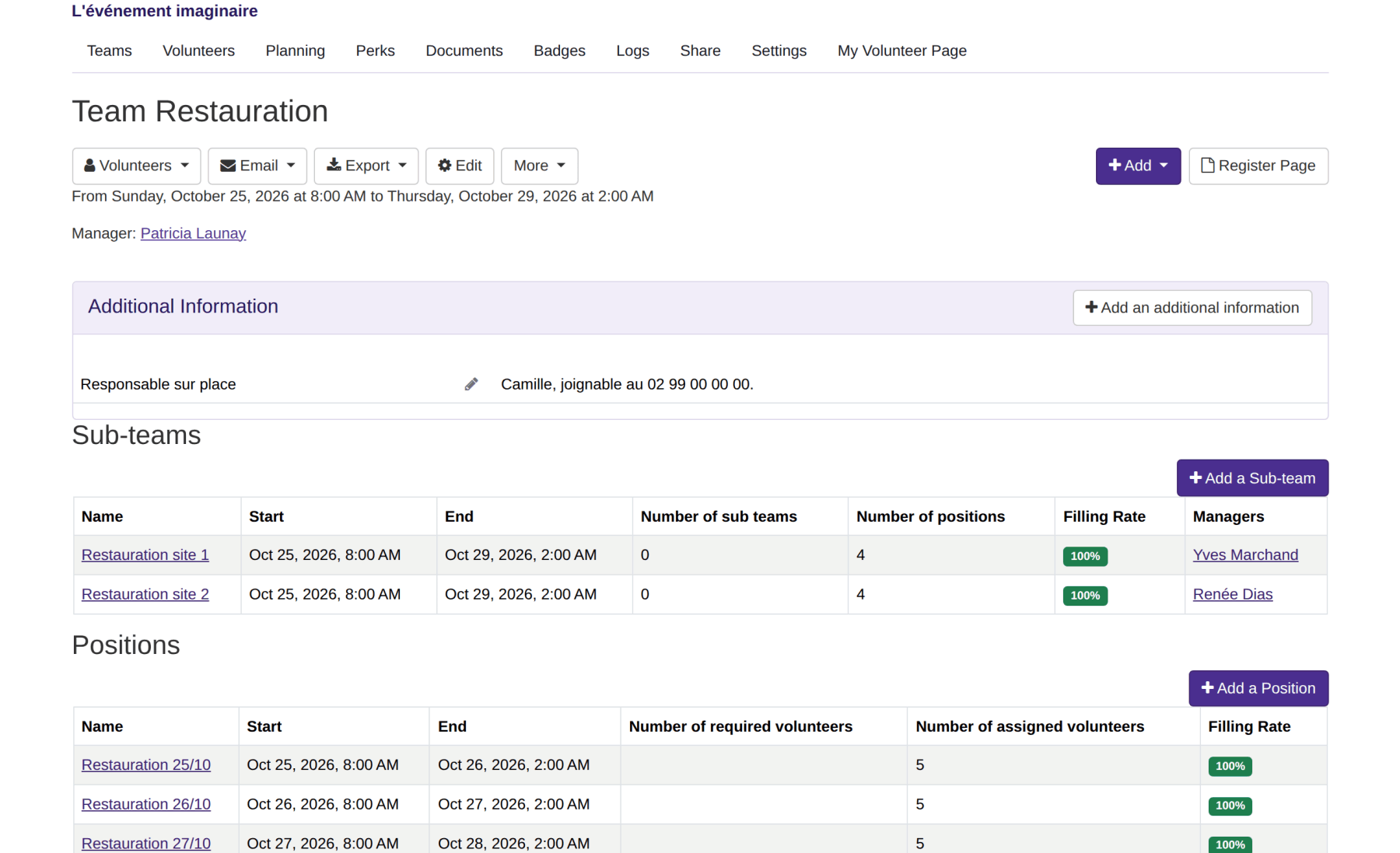
Inside a team, a position says what has to be done and between which hours: the Saturday bar, from 8am to 2am. A team splits into sub-teams where it needs to, by site or by day, each with its own leads.
The next edition is created from this one, with its teams, its positions, their hours and their requirements. You adjust what changed, the rest is already there.
Requirements are declared hour by hour
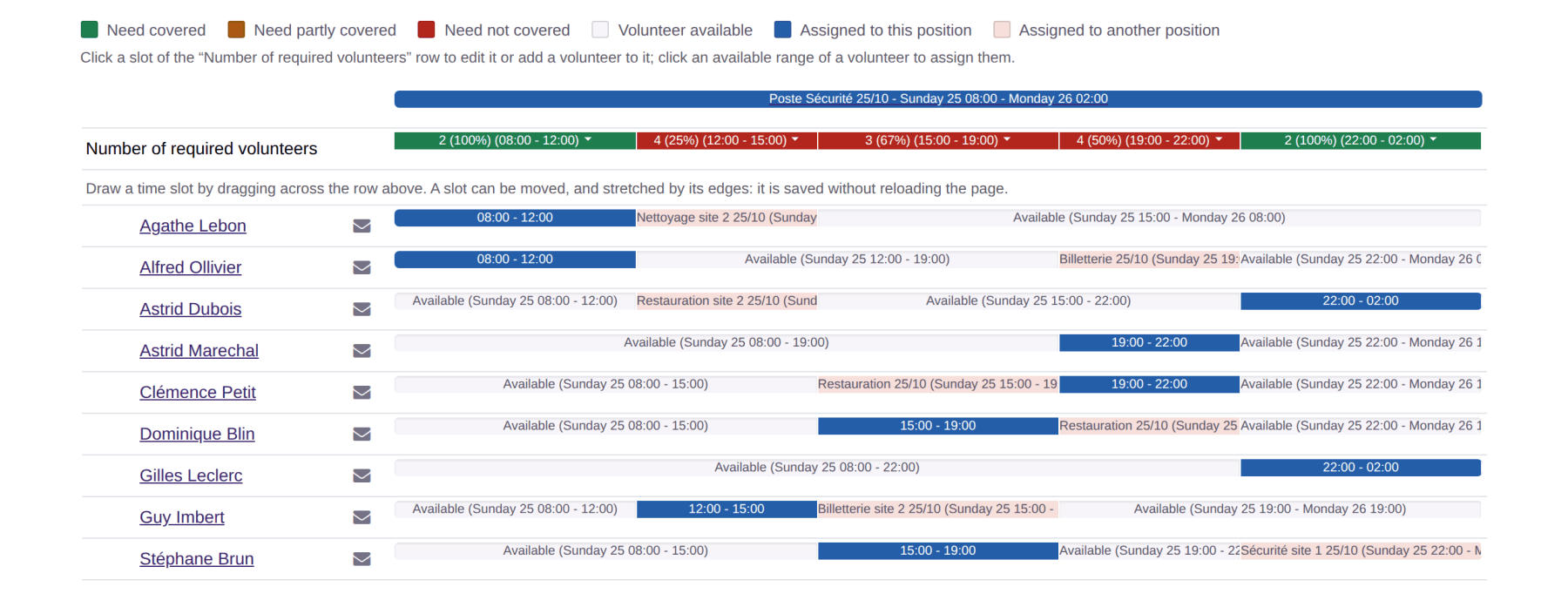
A position does not need the same headcount all day: two people from 8am to noon, four from noon to 3pm. The filling rate is read on those bands, and that is where a gap shows up while there is still time to fill it.
Opposite, every volunteer shows the availability they declared and the positions they already hold. An assignment that contradicts them is refused, every time, without you having to think about it.
Features
Volunteer registration
One public link, a QR code and a form that asks your own questions: applications arrive already sorted by preferred team and by availability.
Volunteer import and export
Bring your list in from a spreadsheet, as CSV or Excel, and take your volunteers, schedules and their answers back out whenever you want.
Volunteer tracking
Filter by status, team, availability or assigned position, choose your columns, and find each volunteer's full history.
Teams and positions
Split the event into teams and positions, hand each team to its lead, and say how many volunteers you need, hour by hour.
Volunteer scheduling
Assign people without ever creating a clash, follow staffing position by position, and send everyone their own schedule.
Shift booking
Let volunteers pick their own shifts, with substitutes and a waiting list, while you keep control of confirmation.
The volunteer's account
Every volunteer has their own page: their next shift, their hours, their documents, their perks, and their calendar up to date on their phone.
Emails to volunteers
Write in two clicks to a team, a position, unassigned volunteers or everyone, from reusable templates.
Documents and mail merge
Call-up letters, certificates, running sheets: one Word template, and one document per volunteer filled in with their details and schedule.
Badges and perks
Print badges with a photo and a QR code, and track the meals, drinks and t-shirts handed to each volunteer.
Volunteer groups
A partner organisation brings its own volunteers? Give it its own sign-up link and its own leads, without opening up the whole event.
A new edition every year
The new edition carries over teams, positions and hours shifted to the right dates, and last year's volunteers are invited back.
Volunteer data and GDPR
Hosted in France, a published processing agreement, and retention periods applied by code rather than merely announced.
Accessibility for volunteers
Measured screen by screen and published: 100% of the applicable RGAA 4.1 criteria, self-assessed, and a statement that also says what that does not cover.
Frequently asked questions
Can a round be limited to trained volunteers?
Yes. A position is only open to the volunteers of a given team, and booking a shift goes through that team manager's approval.
Do volunteers get the make-up of the evening's crew?
Yes, by email, with the meeting point, the hours and the lead's phone number. Mail merge also produces the round sheet to print.
What about the data of the people you meet?
It has no place here: the tool handles your volunteers, not the people you support. Retention periods and the data processing agreement cover volunteer data only.